


What If Anxiety Isn’t the Enemy?
This might sound strange, but I love working with anxiety. When a friend pulls me aside at school pickup and quietly asks, “Can I talk to you about my daughter’s anxiety?” my honest answer is, “How much time do you have?”
That’s because I don’t start where most people expect. I don’t start with how to get rid of anxiety. I start with why we have it at all, and why we don’t actually want it gone.
The Anxiety Pattern
Most of us know what anxiety feels like from the inside. The thought loops. Imagining the worst. Going over the same worry again and again. There’s a quiet belief underneath it: If I think about this enough, I’ll be prepared. I’ll be able to stop something bad from happening.
You know you’re worrying, and you still can’t stop. You’re looking for a certainty you probably won’t get. And anxiety thinks it’s being very responsible by playing out every possible outcome. In fact, it thinks you’re being irresponsible if you don’t.
For me, anxiety shows up in my gut. I’ve had a racing heart. I’ve had a panic attack that felt like a heart attack. And I’ve sat with many clients in my office while they had one. So I know anxiety from my own life and from my clinical work.
Anxiety Is Here on Purpose
You wouldn’t be alive today without your ancestors’ anxiety. It’s part of the system that keeps us safe. When our body senses danger, it shifts into fight-or-flight, and anxiety lives there.
I’ll be honest: I’m over the debate about whether anxiety is “technically” an emotion or a cluster of symptoms. We don’t need anyone over-intellectualizing something that’s happening in our bodies. Otherwise we end up anxious about talking about our anxiety the right way.
Here’s what matters. We want enough anxiety online to keep us alive, but not so much that it keeps us from living.
This isn’t about loving your anxiety exactly as it is. It’s about being able to work with it. Where is it trying to keep you safe? Where is it pointing you toward what you care about? And where is it getting in the way, keeping your body stuck in a stress state that you can’t sustain?
Anxiety Means You Care
Anxiety is information. It points at what matters to you.
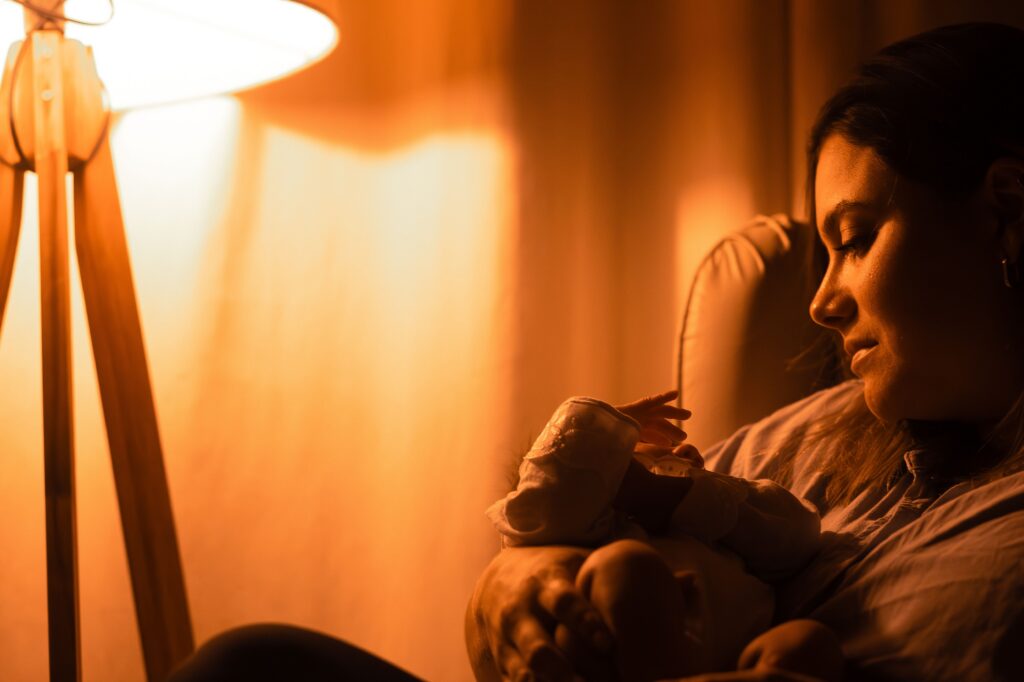
Honestly, I worry more about people who have no anxiety. Picture a mom with a new baby who shrugs at knives on the counter and no baby gates. That’s concerning. On the other end, a mom who can never put her child down isn’t helping either. There’s no perfect spot on this spectrum. The question is: what helps me keep my family safe without keeping me from living my life?
Recently in New England, there were several heartbreaking accidents where tree branches fell on children. Many parents spiraled, and understandably so. Trees are everywhere. For me, that anxiety turned into a conversation with my husband: “We have dead trees over the places where we spend time. We need to cut some of those branches down.”
We’re not cutting down every tree and turning our yard into a beach. But we used that anxiety as information and took action. That’s healthy anxiety. That’s why we need it.
“Am I Making My Daughter Anxious?”
So many moms I work with, especially moms of daughters (I’m one too), carry anxiety about causing their child’s anxiety, or about not being able to help with it.
Here’s what I say gently: you are not causing your daughter’s anxiety. She was born with a nervous system. Don’t give yourself that much credit. You’re both human, and your biology leads you both to feel anxious.
What you are doing is modeling a pattern: how you relate to anxiety and what you do when it shows up.
A Yale study called SPACE looked at 124 anxious children aged 7 to 14. One group of kids received cognitive behavioral therapy. In the other group, the kids received no therapy at all. Only their parents were trained. Those parents learned to accept their child’s anxious feelings, to show confidence that their child could cope, and to stop organizing family life around preventing anxiety.
The result? Training only the parents worked just as well as therapy for the child.
That last piece matters. Anxiety grows when we avoid what we’re anxious about. If your child is anxious about school and gets to stay home, school gets scarier. So helping our kids with anxiety starts with changing what we do when their anxiety sets off ours. And that comes back to how we relate to our own.
If you want to go deeper, Lynn Lyons’ book Anxious Kids, Anxious Parents completely changed how I understand anxiety.
The Other Side of Anxiety: Playfulness
A few years ago, I had an ancestor session. At the end, I asked about my left knee, which has had three surgeries and has carried a lot of my anxiety. I wanted someone to tell me I’d still be skiing at 80.
Instead, the answer I got was playfulness. When you awaken playfulness, the ruminating will fall away.
My first reaction was, “Ugh, what?” As a mom of young kids, playfulness felt completely out of reach. But it made so much sense. When we feel safe and grounded, we can be playful, and we can’t be playful and anxious at the same time.
If you ride a Peloton, you know the volume setting that lets you choose “more instructor” or “more music.” That’s how I see rewiring. Anxiety still has a place. We just turn up the volume on playfulness and turn it down on anxiety, so anxiety isn’t the loudest voice in the room.
How We Work With Anxiety in REWIRE
In REWIRE, we work with patterns like anxiety in two ways. First, we get to know the pattern in the body: we meet it, respect it, and learn what helps it soften. Then we strengthen what lives on the other side of it, like groundedness, calm, and play.
And because everything is connected, working with anxiety often brings relief to perfectionism, shame, and more. We work locally, and it shows up everywhere.
The goal isn’t to get rid of anxiety. It’s to become the calm presence people feel when they walk into a room with you, so your kids learn from you what healthy anxiety looks like.
REWIRE: What You Keep Repeating starts in late October. Learn more at theschoolofmom.com/rewire.
Listen to the full episode, Let’s REWIRE… Anxiety, on the podcast.


+ show Comments
- Hide Comments
add a comment